Click here to view this email in your browser.
|

|
|
|
|
|
August 2026: Message from the CEO

|
August has been a month of turning evidence into asks, and of getting ready for a stretch of the year when the decisions that matter most to disabled people will be made.
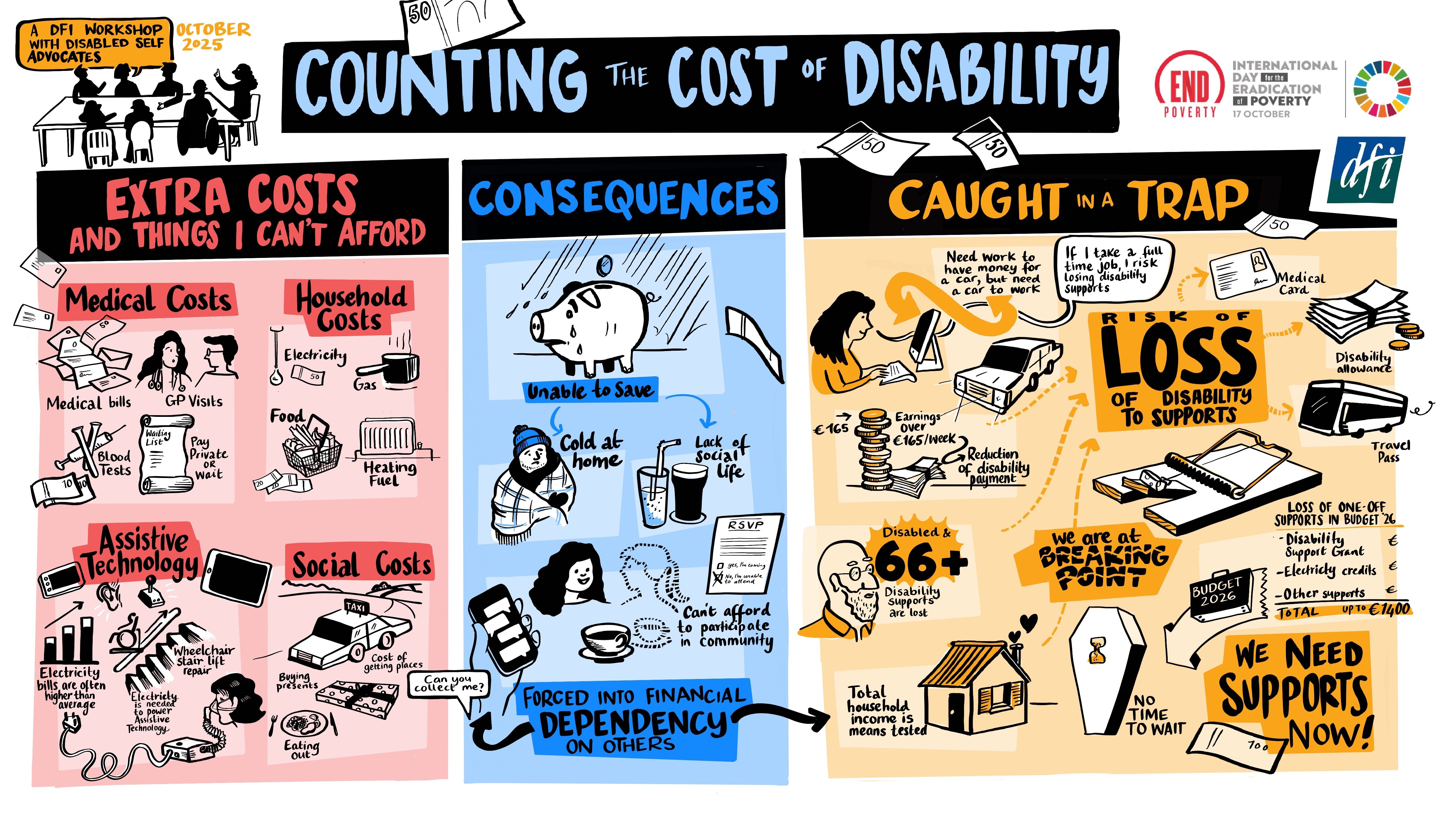
In the aftermath of Budget 2026, we worked with an artist to turn a workshop we held with disabled advocates into an illustration that brings the reality of disability poverty to life. It is a powerful account of why urgent action is needed, and of what our pre-Budget submission 2027, "The least we can expect", sets out to address, chief among its asks a recurring €55 weekly Cost of Disability payment to begin closing the gap between what disability costs and what people can afford.
When the sector speaks with one voice on the big asks, it is much harder for Government to look away. But a unified position does not mean a single story. If your organisation has produced its own pre-Budget submission, send it to us and we will feature it alongside the others on the DFI website, showing Government the full scale of what the sector is asking for while keeping your specific priorities front and centre. There is no set format and no deadline, so send it on as soon as it is published.
Ireland assumed the Presidency of the Council of the European Union on 1 July, and its programme specifically commits to championing the full participation of disabled people in Europe's social and economic life. DFI is already working to keep disability rights in focus, including a number of disability-related events here in Ireland in October.
Our member consultation on the review of the Disability Act 2005 took place on 6 August, and the insights shared will directly shape our submission. Encouragingly, the deadline has now been extended to 9 October, which gives us welcome time to keep working with you as our draft takes shape.
If there is anything you would like to raise, we want to hear from you, so please get in touch with Meredith Raley on the team.
Finally, we are recruiting a Policy Advocacy Manager to help lead our policy programme at a genuinely pivotal moment, so please share the role across your networks.
I look forward to continuing this work together.
Kind regards,
|
Elaine Teague CEO
Disability Federation of Ireland
|
|
|
|
|
|
|
|
|
|
Spotlight
|
|
|
Counting the Cost of Disability
|
|
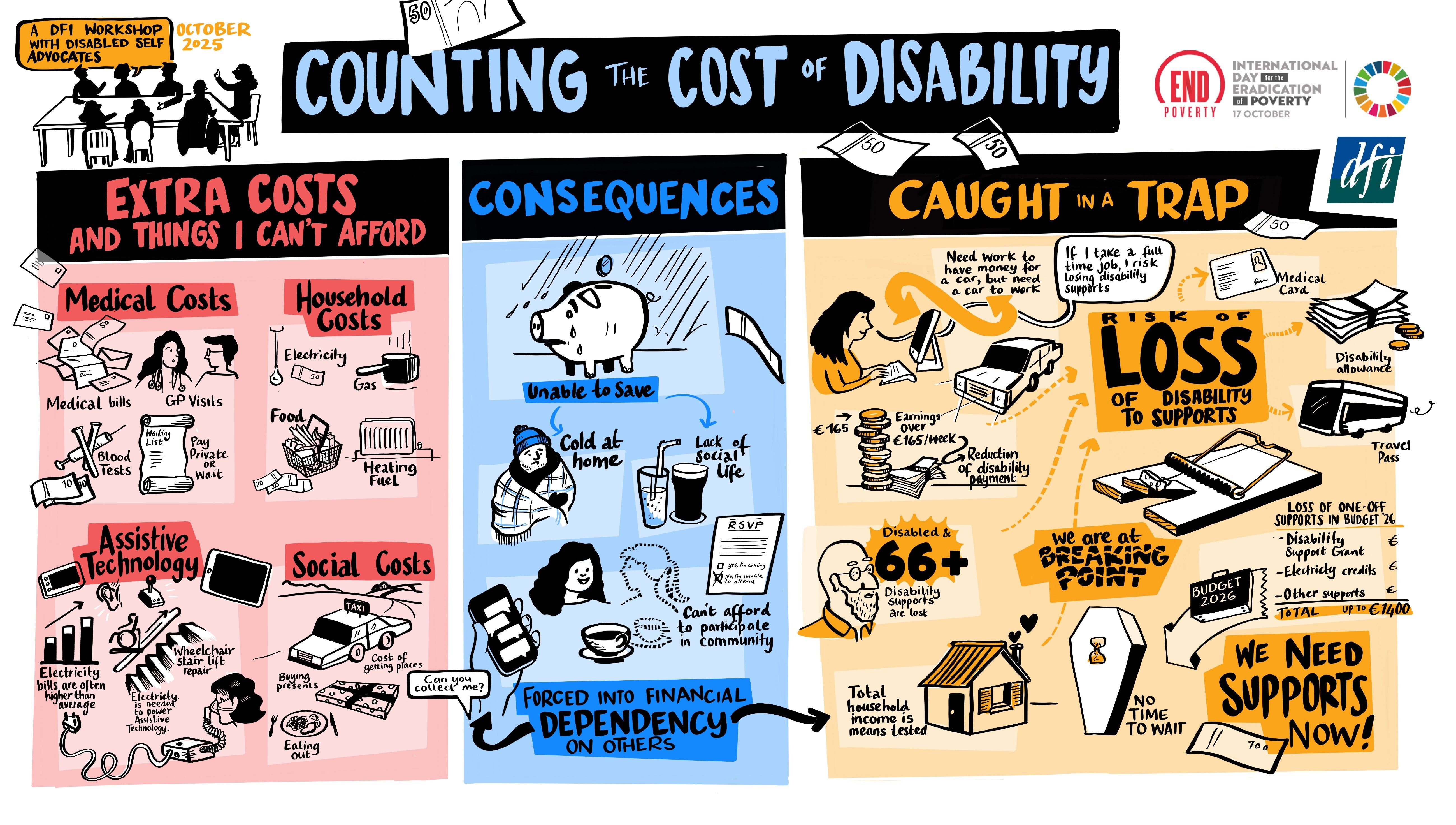
After Budget 2026, DFI held a workshop with disabled advocates to explore the reality of disability poverty. We discussed the everyday extra costs, the knock-on consequences, and the poverty trap that so many people are caught in.
To capture the discussion, we worked with an artist to create an illustration that brings these lived experiences to life. Produced to mark the International Day for the Eradication of Poverty (17 October), the piece is a powerful visual account of why urgent action is needed.
Extra costs
Disability brings extra costs that many people simply cannot meet. Participants spoke about medical costs, including bills, GP visits, blood tests, and the choice between paying privately or waiting on a list. Then there's household costs such as electricity, gas, food and heating fuel. Electricity bills are often higher than average because power is needed to run essential equipment, and there are ongoing costs like wheelchair and stairlift repairs.
Social costs, from the price of getting places to buying presents or eating out, mean participating in everyday life comes at a premium.
These are not small sums. Research puts the additional cost of disability at between €11,046 and €15,617 a year. That's simply to reach the same standard of living as a non-disabled person.
The consequences
These costs have real consequences. People described being unable to save, cold at home, and cut off from a social life. Many can't afford to participate in their community, and are often forced into financial dependency on others.
Caught in a trap
The illustration captures the poverty trap at the heart of the system. People need work to afford a car, but need a car to get to work. Yet taking on a full-time job risks the loss of vital disability supports. Earnings over €165 a week trigger a reduction in disability payments, and can put the Medical Card, Disability Allowance and Travel Pass at risk. For those who are disabled and aged 66 or over, disability supports are lost altogether. Household income is means-tested, leaving people with no room to get ahead.
The picture was made worse by Budget 2026, which withdrew the one-off cost-of-living supports and put nothing lasting in their place.
What Budget 2027 must deliver
This is exactly what DFI's Pre-Budget Submission 2027, The least we can expect, sets out to address. The workshop confirmed that people are at breaking point, and there is no time to wait.
At the heart of our submission is the call to finally introduce a Cost of Disability payment, a recurring €55 weekly payment to begin closing the gap between what disability costs and what people can afford. Unlike one-off measures that come and go with each Budget, a recurring payment offers the certainty people need to plan, to save, and to live with dignity.
Alongside this, we are calling for reform of the means test and earnings rules that punish ambition, so that taking up work no longer means risking the supports people rely on.
Budget 2027 is the first real test of the Government's commitments under the new National Human Rights Strategy, and comes as Ireland faces its first UN hearing on disability rights. The same access to services and supports as everyone else is the least disabled people can expect.
|
|
|
Join our team: We're looking for a Policy Advocacy Manager
|
|
Our mission is to work alongside our members, disabled people, allies and the state to drive full inclusion and equity. We aim to build an Ireland where disabled people shape their own lives and take part in their communities with equality, inclusion and independence.
Now we're looking for someone to help lead that work.
We're recruiting a Policy Advocacy Manager to join our team at a genuinely pivotal moment for disability policy in Ireland. Working closely with our Director of Advocacy, this person will lead our dedicated policy team and help deliver DFI's policy programme.
What you'll do:
- Lead analysis of disability-related public and social policy
- Influence policy development and represent DFI at a high level
- Build strategic relationships with government, statutory agencies and civil society
- Engage our members to keep their voices at the heart of our
- work.
The details:
- Permanent, full-time | €55,000–€60,000
- Based in Dublin City Centre, with flexible hybrid working
- Closing date: 17 September 2026.
DFI is an equal opportunities employer, and we particularly welcome applications from disabled people.
Reasonable accommodations are available throughout the recruitment process.
To apply, send your CV and cover letter to jobs@disability-federation.ie.
Full details of the role are here.
|
|
|
Share your Pre-Budget Submission with us
|
|
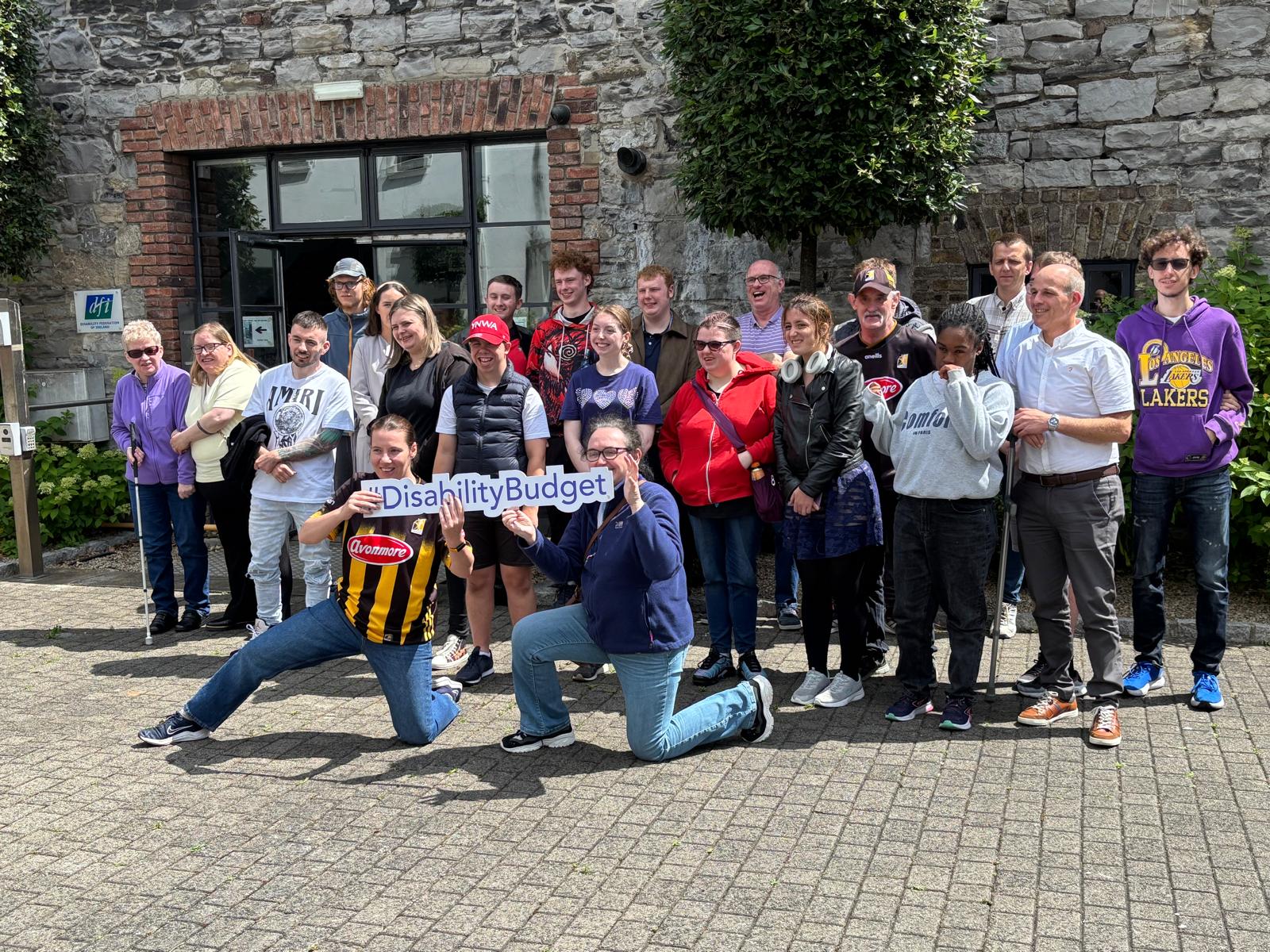
Last month we shared DFI's Pre-Budget Submission 2027, "The least we can expect", setting out what disabled people need from Budget 2027 and why this is the moment Government must deliver on the promises it has made.
Those asks were shaped by our members and the lived experience of the disabled people, families and frontline staff our members support every day.
Stronger together
That collective weight matters. When the sector speaks with one voice on the big asks, including the Cost of Disability payment, sustainable funding for voluntary organisations, accessibility built in from the outset, it is much harder for Government to look away.
Your priorities, your voice
A unified position doesn't mean a single story. Our members bring specific expertise and priorities that no umbrella body can speak to as well as you can.
Send us your submission
If your organisation has produced its own pre-Budget submission, send it to info@disability-federation.ie and we will feature it on the DFI website. Bringing them together in one place shows Government the scale of what the sector is asking for, while keeping each organisation's specific priorities front and centre.
There's no set format and no deadline. Just send it on as soon as it's published, and we'll take it from there.
|
|
|
Actioning Advocacy
|
|
|
DFI Holds Member Consultation on the Disability Act 2005 Review
|
|
On 6 August, DFI held a consultation with members on our submission to the review of the Disability Act 2005. The insights and perspectives shared will directly inform our submission as it develops.
Importantly, the deadline for submissions has been extended to 9 October. For DFI, this extra time is a welcome opportunity to engage further with members as our draft takes shape, ensuring our final submission reflects the priorities of the sector.
If there's anything you'd like to raise in relation to DFI's submission, we want to hear from you. Please get in touch with Meredith Raley at meredithraley@disability-federation.ie.
Members who are interested in preparing their own submission can find full details on the consultation here: Public consultation to inform the review of the Disability Act 2005.
|
|
|
|
|
|
Members Newsfeed
|
|
|
DDAI Survey: Proposed Introduction of a Vehicle Adaptation Scheme (VAS)
|
|
DFI member, the Disabled Drivers Association of Ireland (DDAI) is conducting a survey to understand how the removal of some or all existing financial supports could affect disabled drivers and passengers, their families and carers, and others who rely on the Disabled Drivers and Disabled Passengers Tax Relief Scheme (DDPTRS).
Feedback from the survey will help DDAI represent the views of those affected and highlight the potential impact of any proposed changes.
You can complete the short survey here: DDAI Survey – Proposed Vehicle Adaptation Scheme.
Background: The DDPTRS
The Disabled Drivers and Disabled Passengers Tax Relief Scheme was introduced by the Irish Government in 1968 to support people with disabilities to purchase and use a vehicle, either as a driver or as a passenger. The current scheme provides important financial supports, including:
-
Exemption from Vehicle Registration Tax (VRT)
-
Refund of VAT
-
Exemption from motor tax
-
Refund of duty paid on petrol and diesel, up to a maximum of 2,730 litres
-
Exemption from toll charges on toll roads in the State.
Proposed Vehicle Adaptation Scheme (VAS)
The proposed Vehicle Adaptation Scheme is a standalone scheme, administered by the Department of Transport, for drivers and passengers who require vehicle adaptations to enable them to enter, exit or operate a vehicle. As currently outlined, however, the VAS does not include the wider financial supports available under the existing DDPTRS.
While the Government has stated that the VAS is separate to the DDPTRS, the DDAI is seriously concerned that the DDPTRS may be removed completely, leaving only the VAS in place. If this happens, many disabled drivers and passengers could be left significantly worse off financially, particularly those who rely on the current supports to purchase, adapt and run a suitable vehicle.
Your feedback will help ensure the voices of those affected are heard. Please complete the survey and share it through your own networks.
|
|
|
|
|
|
|
|
|
|
|
|
National Ability Supports System: 2025 Data on Children's Residential Services
|
|
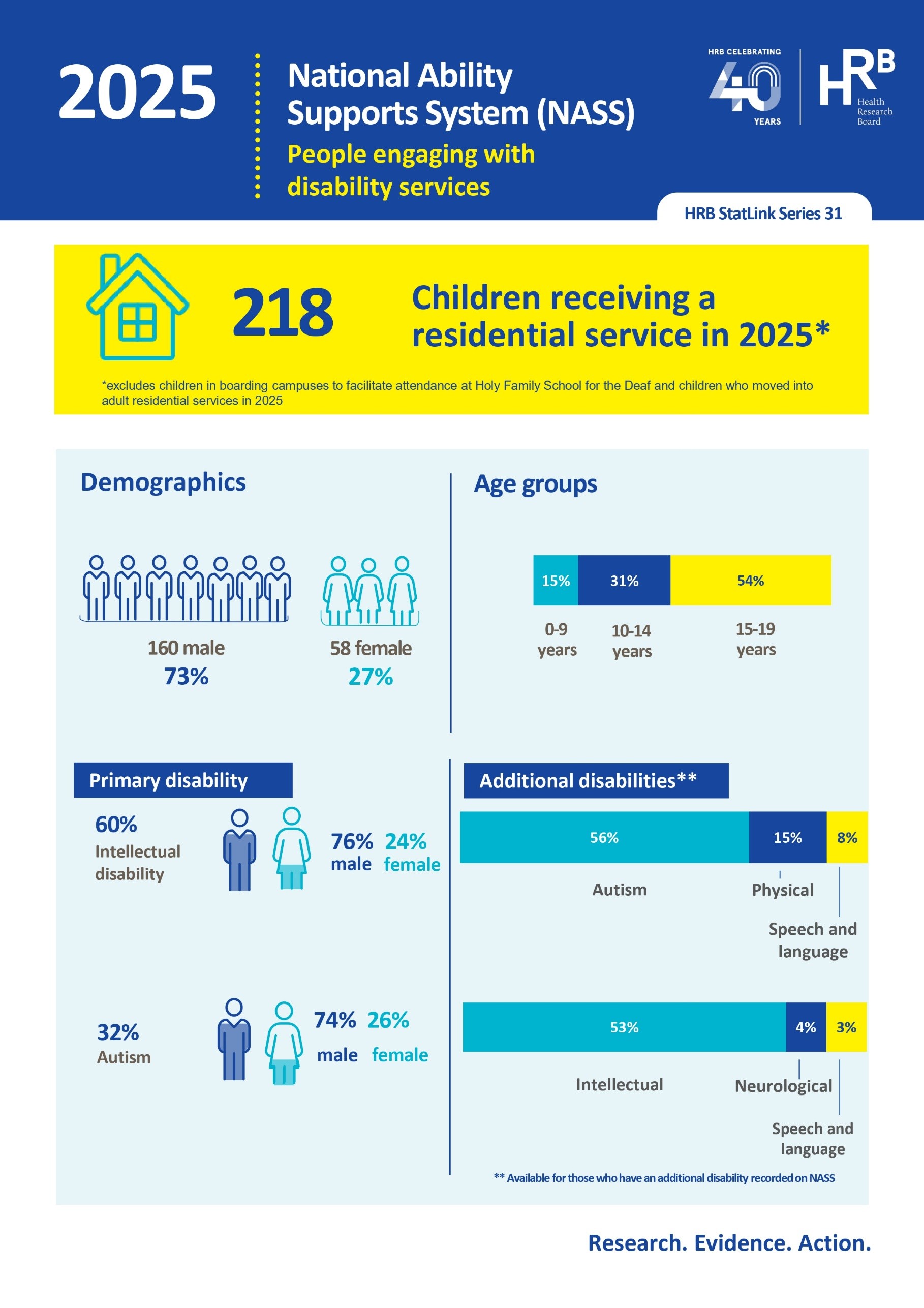
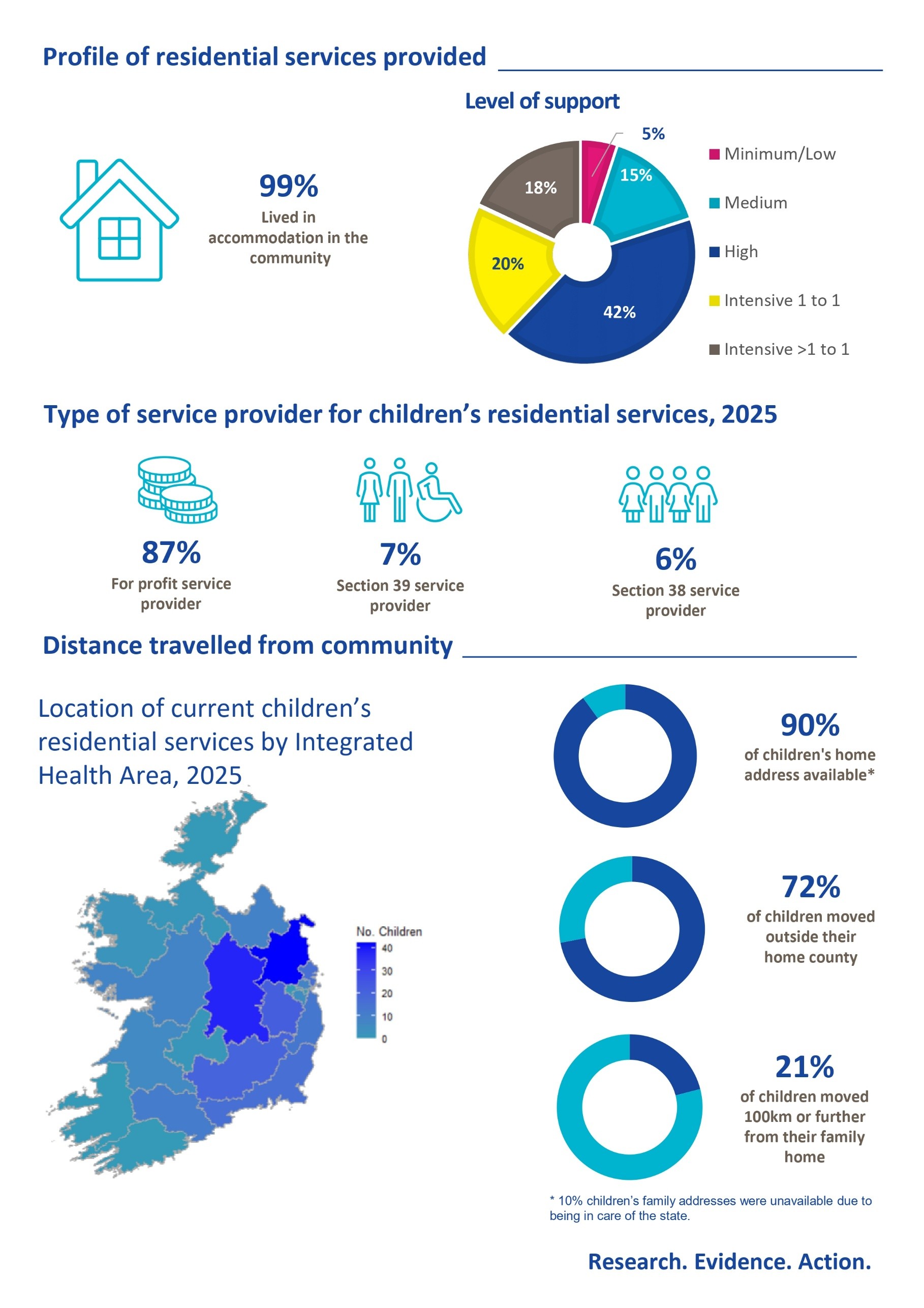
The National Ability Supports System (NASS) team has developed a new infographic based on the 2025 data on Children's Residential Services. It's also available on the Health Research Board (HRB) website.
Key findings from the infographic include:
- There were 218 children in children's residential services at the end of 2025. This figure excludes children residing on boarding campuses to facilitate attendance at the Holy Family School for the Deaf.
- Just over half of all children were aged 15–19 years, and 60% had a primary disability of intellectual disability.
- 87% of children's residential services were provided by for-profit service providers.
- Of the 196 children whose family address was known, 72% had moved outside their home county, and 21% had moved 100km or more from their family home.
|
|
|
Paid Research Opportunity (€70): Help Shape ISL and Subtitling on Irish TV and Video-on-Demand
|
|
Tilting the Lens, a Disabled-led accessibility consultancy, has been awarded a piece of work by Coimisiún na Meán, Ireland's media regulator, to research the quality of Irish Sign Language (ISL) and subtitling on Irish broadcast television and video-on-demand. To ensure the work is Deaf-led and co-designed with Deaf people, they have partnered with Sofiya Kalinova BL and Trinity's Centre for Deaf Studies.
As part of this research, Tilting the Lens is seeking 100 d/Deaf, DeafBlind and Hard-of-Hearing people from across the island of Ireland to complete a paid survey. They are especially keen to hear from people with diverse backgrounds and intersectional lived experiences (for example, LGBTQ+, Traveller/Roma, youth, or ethnic minorities).
- Compensation: €70 per participant
- Accessibility: The sign-up form is accessible, with embedded ISL throughout and a plain language version available.
The research aims to set a new baseline and result in meaningful recommendations to Coimisiún na Meán.
To take part, complete the Expression of Interest form (with ISL embedded).
You can also find out more on Instagram and LinkedIn, or watch two ISL videos with more information.
If you know colleagues, members or networks who may be interested, please help spread the word.
|
|
|
|
|
|
|
|
Events and Consultations
|
|
|
CHAT – CREATE III: What's Next? Exploring the Next Generation of CREATE-Funded Innovation
|
|
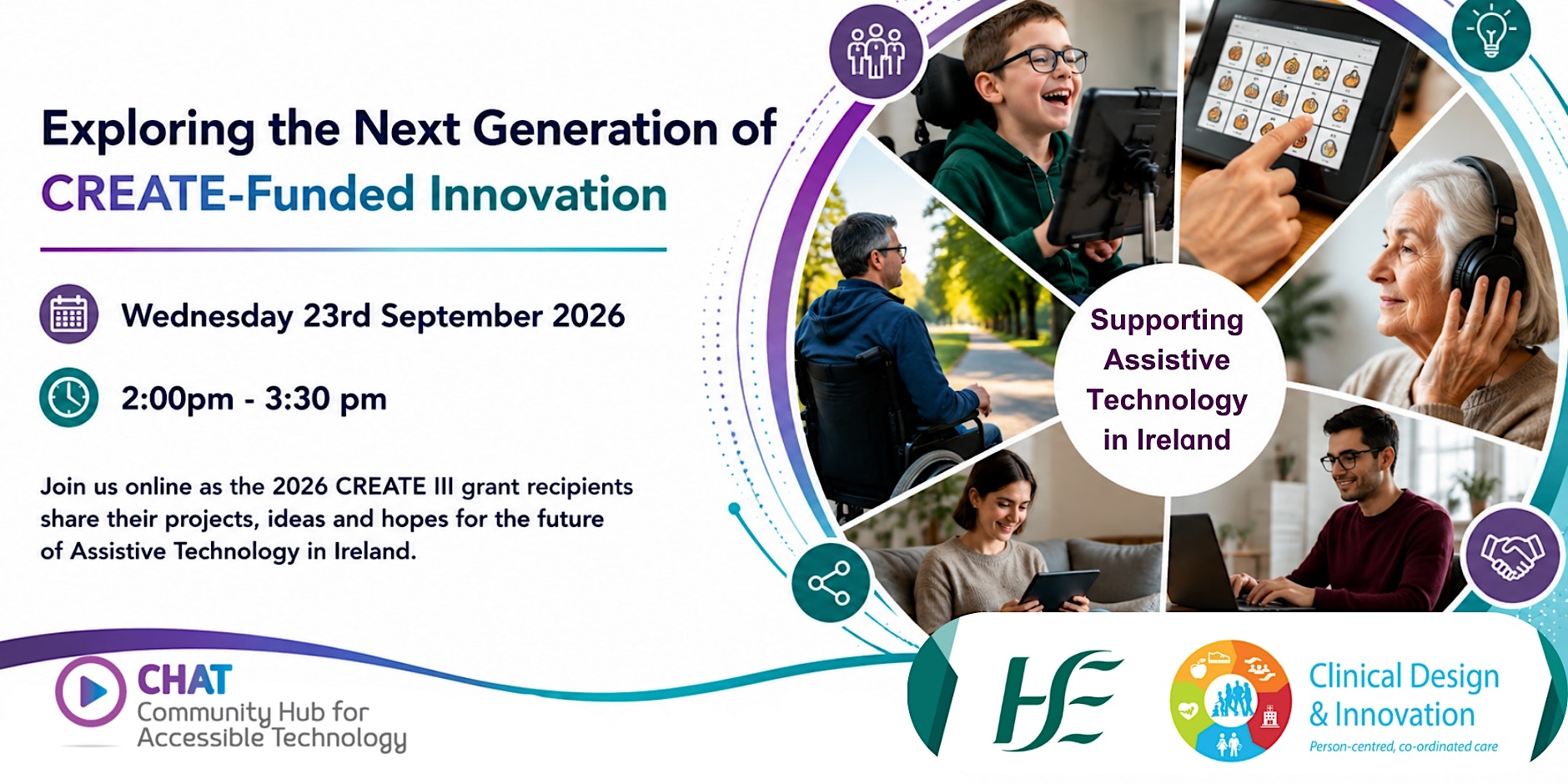
FreedomTech invites you to its next online CHAT (Community Hub for Accessible Technology) gathering, bringing together the nine 2026 CREATE III-funded projects.
Wednesday, 23 September 2026, 2pm – 3.30pm | Online via Zoom.
CREATE III is supporting an exciting range of work across Assistive Technology, digital inclusion and accessibility in Ireland. The projects span early powered mobility and Assistive Technology for young children, accessible information, and peer-led digital support. Others focus on employment, positive ageing, and technology access for people who are deafblind.
The session will be opened by Professor Rosemary Gowran, Clinical Lead for the National Clinical Programme for People with Disability.
Meet the CREATE III projects
During the 90-minute session, you'll hear directly from all nine projects about what they are doing, what they hope to achieve, and the difference they want to make.
But CHAT is about more than presentations. It's a space to ask questions, share learning, make connections, and identify opportunities to collaborate as these projects develop. Whether you use Assistive Technology yourself or work in disability services, health, education, research, technology, policy or advocacy, FreedomTech would love you to join the conversation.
Come and discover what's happening, and help explore what's next for Assistive Technology in Ireland.
Register for your free place.
The event is free and open to everyone. FreedomTech aims to make CHAT as accessible as possible. If there are any supports or accommodations that would help you take part, please note this when registering.
Please note that this session will be recorded. Further information and consent options are provided during registration.
For any queries, contact Sarah at Sarah@freedomtech.ie or find FreedomTech on social media at @Freedomtech_Irl.
|
|
|
New ESF+ funding call to support women in employment
|
|
A new ESF+ funding call is open to support women in overcoming the barriers they face in employment, in line with the objectives of the National Strategy for Women and Girls.
The funding scheme supports gender equality projects under the Employment, Inclusion, Skills and Training Programme (EIST), part of Ireland's ESF+ programme for 2021 to 2027.
Improving women's access to employment opportunities and economic empowerment are key features of the National Strategy for Women and Girls 2025–2030. This funding call supports these policy objectives of the Strategy and its associated Action Plan.
Apply for funding here.
Deadline: 30 August.
|
|
|
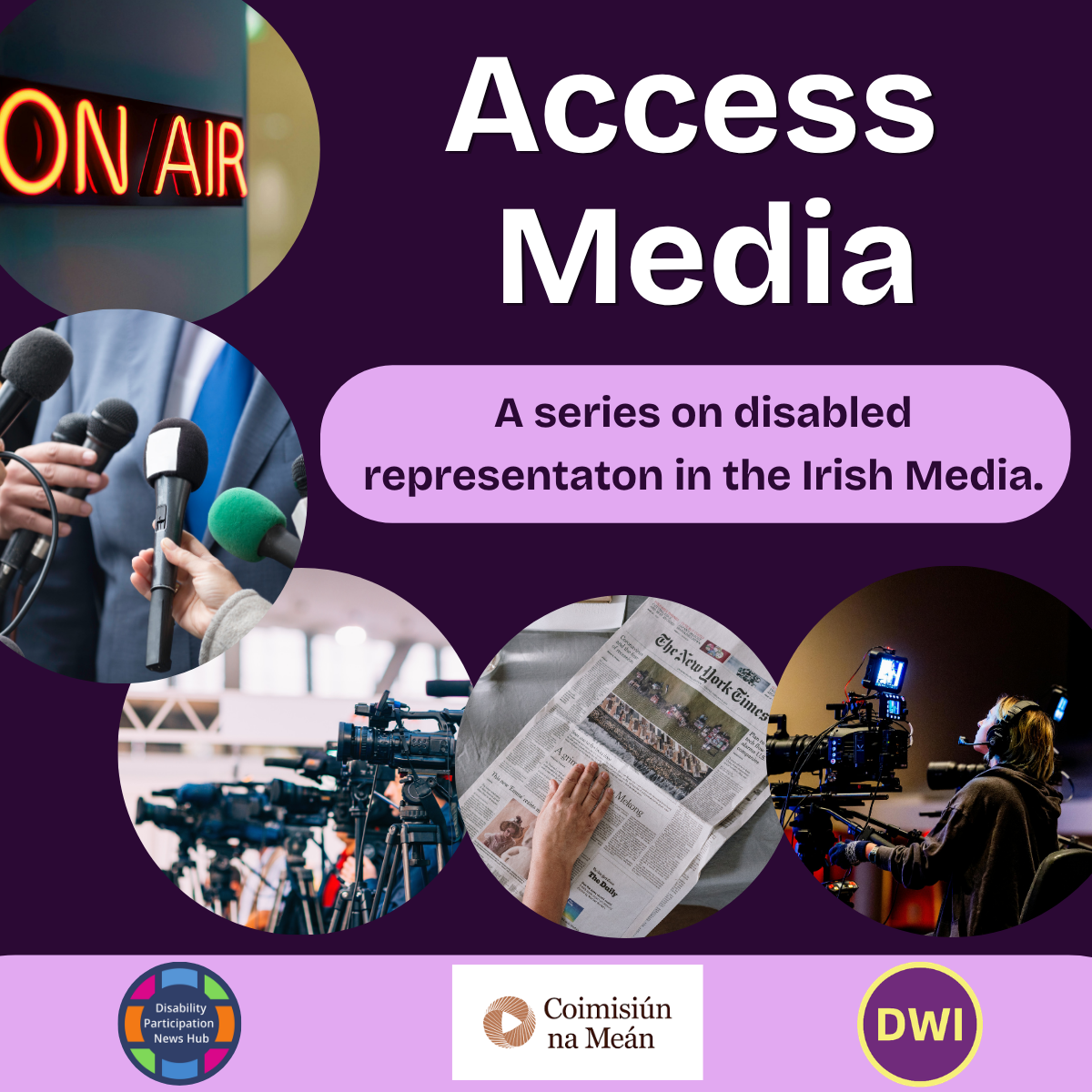
Access Media: A series on Disabled Representation in the Irish Media
|
|
Calling all media and communications professionals!
Would you like to learn more about how you can make Irish media more inclusive when it comes to the representation of disabled people?
The Disability Participation News Hub are delighted to once again join forces with Disabled Women Ireland, with the support of Coimisiún na Meán, to raise awareness about how disabled people are represented in Irish media, and how we can all play a part in creating change.
Our Access Media Series aims to connect you with disabled people working behind the scenes, on our screens, and across all forms of media, on the challenges and opportunities in accessing and working in these spaces, and what can be done to further inclusion and representation.
Sessions will take place online from July to November 2026, featuring webinars and panels where you can learn more on the following topics:
- Session 1: Language and Ethical Storytelling
- Session 2: Accessing Production Spaces in Ireland as a Disabled Person
- Session 3: Representation of Disabled People in Irish Journalism
- Session 4: Representation of Disabled People in Irish Film, TV and Broadcast Media
- Session 5: Misinformation and Disinformation in the Media – The Impact on Disabled People.
ISL interpretation will be available for each session.
Register via Eventbrite and spread the word with your networks!
Keep an eye on social media for speaker updates and highlights.
This series is supported by Coimisiún na Meán.
|
|
|
Call for papers: ISBA 2027 Conference, Galway
|
|
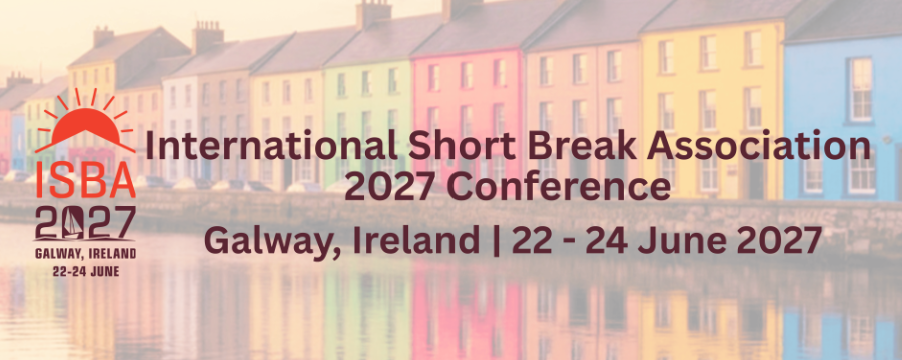
DFI member Ability West has launched the call for papers for the Internation Short Break Association (ISBA) 2027 international conference, bringing together voices from across research, practice and lived experience.
Date: 22–24 June 2027
Venue: Galway, Ireland
Submission deadline: 23 October 2026.
About the conference
The conference will explore how respite can be a bridge to opportunity, inclusion and connection, supporting individuals and families at every stage of life.
Who can submit
Submissions are invited from:
- Researchers and practitioners
- Individuals and families with lived experience
- Community partners and organisations.
Ability West is looking for insights on innovation, inclusion and real-life impact, to help shape the future of support systems.
Submit your abstract.
|
|
|
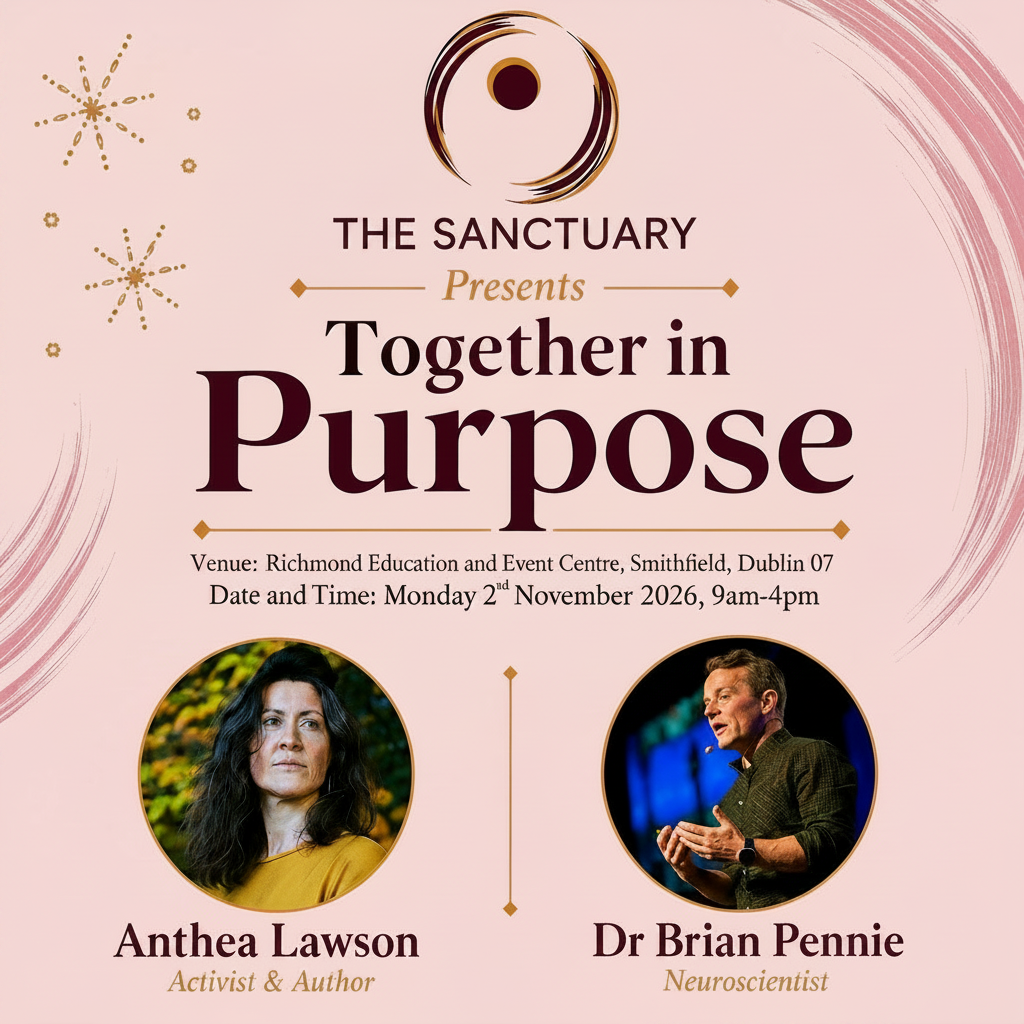
Together in Purpose: A conference on personal growth for social impact
|
|
DFI member The Sanctuary is hosting an immersive day of workshops, lectures and mindful activities with activist and author Anthea Lawson and neuroscientist Dr Brian Pennie.
Date: Monday 2 November 2026, 9am to 4pm
Venue: Richmond Education and Event Centre, Smithfield, Dublin 7.
About the conference
Inspired by the vision of The Sanctuary's founder Sister Stan, 'Nourishing Personal Growth for Greater Social Impact', this workshop-focused conference invites participants to explore growth as a catalyst for positive social change.
Guided by Anthea Lawson and Dr Brian Pennie, the day offers an interactive space for reflection, dialogue and action. Drawing on their experience in community development, social innovation and values-based leadership, they will support participants in examining how inner transformation can translate into meaningful contributions to society.
Through workshops, collaborative exercises and storytelling, attendees are encouraged to connect their personal aspirations with a broader sense of social responsibility, reimagining personal growth as a shared journey that recognises our collective potential to shape a more just and compassionate world.
The speakers
Anthea Lawson is an activist and writer who has worked on campaigns to shut down tax havens, prevent banks from facilitating corruption and environmental devastation, and control the arms trade.
At Global Witness, she launched a prize-winning campaign that changed the rules on secret company ownership, resulting in new laws in dozens of countries. She has published opinion pieces in the Financial Times, Guardian and New York Times, and essays in Dark Mountain, where she has also worked as an editor.
Dr Brian Pennie is a neuroscientist, resilience expert and speaker. Born in Dublin, he overcame a 15-year heroin addiction in 2013 and went on to study psychology, ultimately earning a PhD in Neuroscience from Trinity College Dublin.
Who it's for
The conference is aimed at people working in the charity and non-profit sectors, and anyone interested in the intersection between personal growth and societal change.
Find out more and book.
|
|
|
|
|
|
An Eye on Europe
|
|
|
Ireland assumes the Presidency of the Council of the European Union
|

|
Ireland assumed the Presidency of the Council of the European Union on 1 July 2026. The Council is one of the three main EU institutions, and its Presidency rotates every six months.
This means Ireland will chair all the relevant Council formations and technical bodies, such as the Education, Employment, and Social Affairs Council meetings of national ministers (EPSCO) and the Social Questions Working Party meetings, which usually discuss issues related to disability. Until the end of 2026, Ireland is therefore the most important point of contact for influencing the work of the Council.
Ireland will also oversee the remaining work on the Council's position regarding the next long-term EU budget, known as the Multiannual Financial Framework. Depending on how quickly the Parliament and the Council approve their respective positions, Ireland may also oversee the first interinstitutional negotiations on some files.
Presidency Priorities
The Irish Presidency has built its Programme around three priorities under the motto 'Strength with unity':
-
Competitiveness – fostering prosperity and wellbeing
-
Values – upholding the foundation of the European Union
-
Security – protecting citizens.
Encouragingly, the Presidency specifically mentions persons with disabilities in its programme, stating under the second priority that it will "champion the full participation of disabled people in Europe's social and economic life".
Some other relevant priorities include:
-
Digitalisation, including Artificial Intelligence and the protection of citizens (including children) online
-
Equality and the promotion of human rights, including women's rights, gender equality and the rights of LGBTIQ+ persons
-
Employment, supporting quality jobs within modern labour markets
-
Prevention and health innovation, including mental health
-
Democracy and the rule of law, including the European Democracy Shield and the EU Strategy for Civil Society
-
The EU's support to Ukraine and accession negotiations with Ukraine, Albania, Moldova and Montenegro.
Disability Advocacy
The European Disability Forum (EDF) is already in touch with the Irish Presidency and with its Irish member, the Disability Federation of Ireland, to ensure disability rights remain in focus. The two organisations will work closely together to plan disability-related events in Ireland in October, including an EDF Board meeting, and EDF will also draw up its regular Presidency Scorecard.
Relevant Events.
A full list of events is available on the Presidency website. The following is a selection relevant to our policy areas:
-
30–31 July: High Level Conference: Listening to Children and Young People – Challenges in Challenging Settings
-
9 September: High Level Conference on Equality
-
10–11 September: Conference on Online Safety for Children and Young People
-
15–18 September: 2026 Annual Conference of the European Society for Prevention Research on Innovation in Prevention to Support Health Equity
-
27–30 September: EU Youth Conference
-
6 October: High Level Conference on Non-Discrimination (LGBTIQ+ rights)
-
9–10 October: Inclusive Education – Shaping an Inclusive and Empowering Higher Education System
-
12–13 October: Unlocking Skills Mobility: The Role of European Transparency Tools to Drive the Skills Portability Initiative and Talent Mobility
-
13–14 October: Data in Motion: Connecting Care and Enabling Innovation through the European Health Data Space (EHDS)
-
15–16 October: AI in Science Summit 2026 (AIS26)
-
15 October: Resilient Europe: Mental Health as a Strategic Asset for Europe's Strength and Competitiveness
-
19 October: EPSCO Council meeting (in Luxembourg)
-
22–23 October: High Level Conference on Persons with Disabilities (more information to follow)
-
6 November: Empowering Europe's Regional Economies Through AI Skills
-
23 November: One Health in Action: Surveillance, Innovation and Resilient Systems
-
7 December: EPSCO Council meeting (in Brussels)
-
10–11 December: Conference on the Rule of Law.
|
|
|
EDF calls for disability rights in the next EU action plan on human rights and democracy
|

|
The European Disability Forum (EDF) is calling on the EU to ensure that disability rights are fully reflected in the next EU Action Plan on Human Rights and Democracy.
EDF presented its recommendations during the European External Action Service's civil society consultation on 2 July. The discussion comes at an important moment. There is no separate disability action plan for external action under the EU Disability Rights Strategy. Instead, disability rights are expected to be addressed through broader EU external action frameworks, including the Human Rights and Democracy Action Plan.
If this is the approach, disability rights must be clearly visible throughout the new Action Plan. That means concrete commitments, dedicated funding, meaningful participation of Disabled Persons Organisations (DPOs), and strong monitoring and accountability.
Disability rights must not be overlooked
The next Human Rights and Democracy Action Plan, covering the period post-2027, is being prepared at a time when democracy, civic space and human rights are under increasing pressure worldwide.
The EU's external action must reflect its commitments under the UN Convention on the Rights of Persons with Disabilities (CRPD).
Disability inclusion should be mainstreamed across all areas of the Action Plan, while also including targeted measures to address the specific barriers faced by persons with disabilities.
The new Action Plan should ensure that disability rights are included across EU external action, from human rights dialogues and democracy support to humanitarian action, digital policies and Global Gateway investments.
EDF's calls
EDF is calling on the EU to:
-
ensure the meaningful participation of OPDs in the design, implementation and monitoring of EU external action;
-
guarantee accessibility across all EU-funded programmes and initiatives;
-
include clear commitments to implementing the CRPD;
-
provide predictable and accessible funding for OPDs, including local organisations in partner countries; and
-
introduce disability-inclusive indicators to monitor progress and strengthen accountability.
As work on the new Action Plan continues, EDF will keep working with its members and partners to ensure that disability rights remain a clear and measurable priority in the EU's external action.
|
|
|
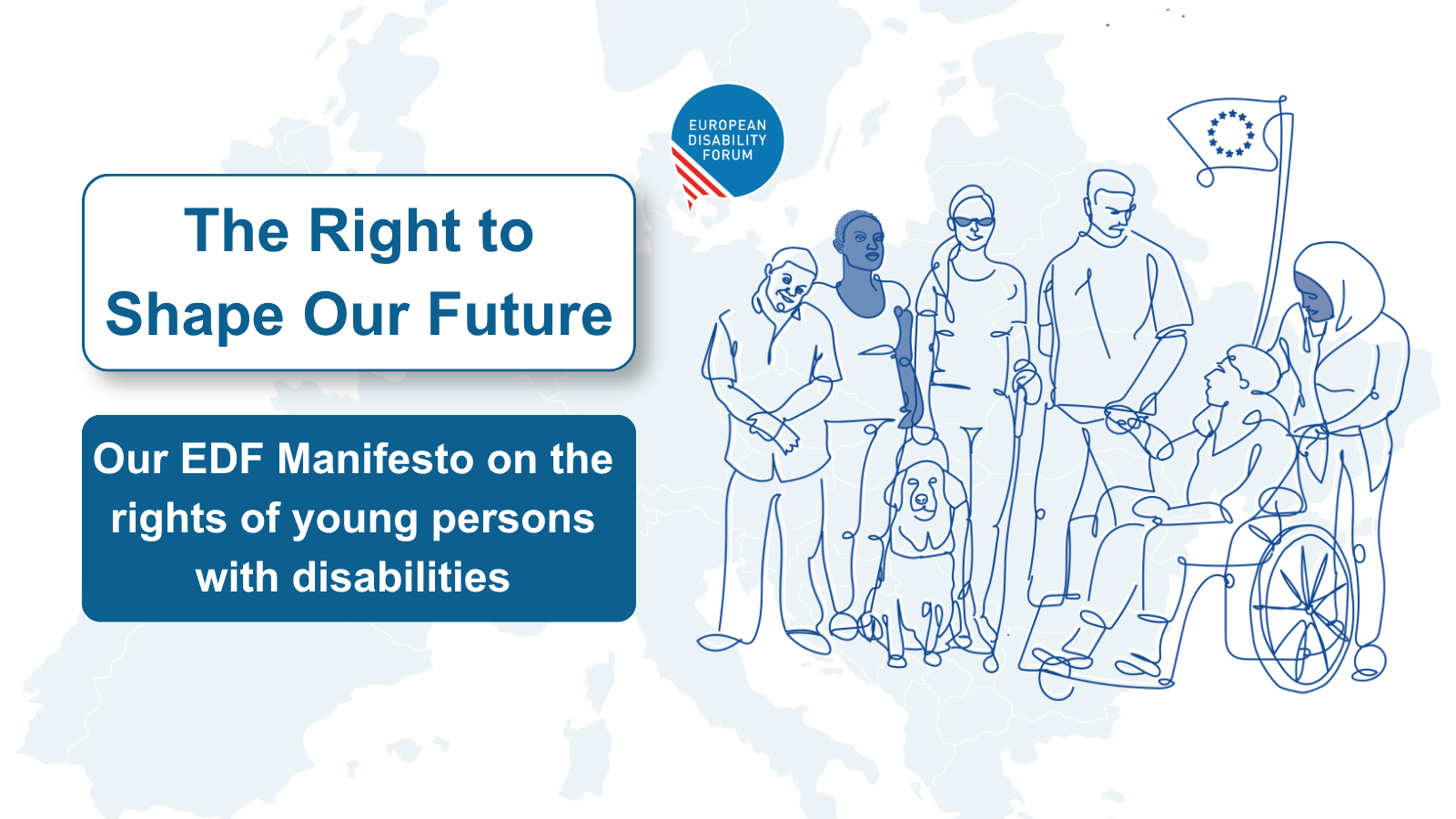
The Right to Shape Our Future: EDF's new manifesto on the rights of young persons with disabilities
|
|
In 2025, the European Disability Forum (EDF) Youth Committee surveyed 183 respondents across the European Union and beyond to gather data on the experiences of young people with disabilities in Europe, and to help inform policies and programmes designed to support them.
The results have shaped The Right to Shape Our Future, EDF's second Manifesto on the Rights of Young Persons with Disabilities.
The right to live in a just and accessible society
For too long, accessibility has been treated as a "polite suggestion" rather than a fundamental right. Persons with disabilities face a "disability tax". They pay more for housing, transport, and healthcare while navigating a world designed without them in mind.
From silent bus stops to inaccessible cafés, the environment remains hostile to independence. True equality requires an infrastructure that anticipates diversity, rather than treating it as an afterthought.
The right to form your own future
Autonomy begins with education and ends with a career, yet many young people with disabilities are funnelled into segregated systems that limit their potential. When schools are segregated, society remains ignorant. When workplaces lack accommodations, talent is wasted. The "poverty trap", where earning a salary leads to a total loss of essential social support, effectively punishes ambition and forces poverty.
The right to shape society
"Nothing about us without us" is not just a slogan; it is a prerequisite for democracy. Too often, information is locked behind inaccessible formats, and the media either ignores disabled lives or reduces them to stereotypes. Without the voices of persons with disabilities in parliaments, newsrooms, and film studios, the cycle of exclusion will never be broken.
Download and read the manifesto
Read the full manifesto and its calls to action for policy makers and the European Disability Movement:
|
|
|
In the news: DFI and members making headlines
|

|
This segment shines a light on DFI and our members making waves in the media, locally and nationally.
Every month, we’ll highlight interviews, articles, and appearances that showcase the incredible work happening across our network. Whether it’s championing rights, sharing lived experience, or shaping policy, our members are leading the conversation, and we’re here to amplify it.
Our media scanning isn't perfect, so if you were in the media over the last month and don't see your segment here, send Tom a link and we'll include it next month!
Ability West
Acquired Brain Injury Ireland
ADHD Ireland
Arthritis Ireland
Association of Occupational Therapists of Ireland
Bluestack
Bodywhys Ireland
Cork Stroke Support
Down Syndrome Ireland
Dyslexia Ireland
Dyspraxia Ireland
Enable Ireland
Family Carers Ireland
FASD Ireland
Galway Autism Partnership (GAP)
Galway Rural Development
Headway
iCARE
Irish Haemophilia Society
Irish Guide Dogs for The Blind
Irish Heart Foundation
Irish Kidney Association
Irish Society for Autism
Irish Wheelchair Association
Mayo Autism Camp
Muscular Dystrophy Ireland
Neurodiversity Ireland
Spinal Injuries Ireland
|
|
|
The DFI Podcast
|
The DFI podcast
|

|
You can find all episodes of The DFI Podcast on Spotify and on our website, where you can also subscribe to future episodes.
If you would like to get in touch with us about the podcast email info@disability-federation.ie. You can find out more about the DFI on our website www.disability-federation.ie.
The DFI Podcast is sponsored by TTM Healthcare.
Our podcast is sponsored by TTM Healthcare.
|
|
|
|
|
|
For more on all of the content featured in our newsletter see www.disability-federation.ie.
If you have been sent this newsletter by a colleague please click here to subscribe directly to receive your own copy of future issues.
|
|
|
|
|
|
Copyright © 2024 Disability Federation of Ireland, All rights reserved.
Disability Federation of Ireland (DFI) is the national support organisation for voluntary disability organisations in Ireland who provide services to people with disabilities and disabling conditions.
Disability Federation of Ireland, Fumbally Court, Fumbally Lane, Dublin 8. Telephone: 01 4547978, Email: info@disability-federation.ie, Web: www.disability-federation.ie
Disability Federation of Ireland, is a company limited by guarantee not having share capital, registered in Dublin, Ireland with offices at Fumbally Court, Fumablly Lane, Dublin 8. Registration Number 140948, CHY No 6177
Click here to unsubscribe or to change your Subscription Preferences.
|


|
|
|
|
|


